News circulating about imminent availability of a new model of desktop APU based on Llano silicon, the A6-3500. Like the four other desktop variants of Llano, this processor will drop into a Socket FM1 motherboard and provide both CPU and graphics processing power to the system.
The specs for the A6-3500 almost exactly like the specs for the next model up, the A6-3600. Both run their CPU cores at 2.1GHz and can raise them to 2.4GHz via Turbo Core, both have 444MHz Radeon IGPs with 320 shader ALUs, and both will fit into a 65W TDP envelope. The difference? The A6-3500 has only three cores and 3MB of L2 cache, versus the A6-3600's quad cores and 4MB of L2.
The A6-3500 is priced at $95, about $40 below the fastest desktop Llano, the A8-3850.
AMD has launched seven mobile parts of A-series "Llano" Fusion APU today, and the desktop models have yet to make an official appearance soon.
AMD is making some bold claims, in terms of battery life where the company is promising up to 10.5h of usable battery life. In fact, AMD claims that its A8-3510MX APU has 3.5h better battery life than a similar notebook with Intel's Core i5-2410M processor.
When it comes to graphics performance, AMD has always had a huge lead here over Intel, but AMD has thrown in a few new features that should further boost the appeal of its APUs. First up AMD has added what the company called Perfect Picture HD which is a post-processing option for cleaning up 1080p video, a feature that might prove popular with people shooting their own HD home videos. The second feature, called Steady Video is rather quite impressive, it actually pre and post processes the video to reduce camera shake and it even works with online videos.
As always, AMD is being very competitive on price and the company is expect notebook with its new APU's to start at US$499 with an A4 APU, whereas with an A6 we're looking at around US$599 and finally A8 models will come in at around US$699. Of course these are best case scenarios and we'd expect a lot more expensive machine to be available as well, depending on configuration. For those looking for a boost to the graphics performance beyond the APU's integrated solution, AMD supports CrossFire on the platform and claim up to a 75 percent performance boost for its discrete mobile GPUs when pairing them up with an APU.
According to some new leaked slides, systems based on AMD's top-of-the-line, A8-series Llano APUs will in fact compete against those based on higher-end Core i5 and lower-end Core i7 processors, with prices of $699 and upward. A6-series Llano chips look set to go against higher-end Core i3s and lower-end Core i5s, while the A4 series will seemingly tackle the lower end of the Core i3 family.
More shocking still, the slide suggests that PCs based on AMD's next-generation E-series processors—Zacate's successor—will compete dollar-for-dollar with systems based on Intel's Pentium processors. However, the slides are dated May 17, which predates the introduction of Intel's new Sandy Bridge-based Pentiums.
Desktop versions of Fusion - Llano accelerated processing units (APUs) by Advanced Micro Devices are likely to be rather inexpensive, which may make them popular among PC builders as well as end-users. According to media reports, the new desktop chips will cost starting from $70.
The initial family of AMD A-series "Llano" APUs will include five chips and beside that, AMD will also offer a low-end E2-series solution featuring Llano design. The most affordable solution in FM1 form-factor will cost $70 (E2-3250), whereas the most powerful A-series chip will be priced at $170 (A8-3550P).
AMD A-series desktop APUs will have either four K10.5+/Husky x86 cores as well as Radeon HD 6000-class "BeaverCreek" (320 or 400 stream processors) graphics core or two x86 cores and "WinterPark" (160 stream processors) integrated graphics engine. The chips will support dual-channel DDR3 memory controllers, up to 4MB of cache, select processors may also feature AMD Turbo Core dynamic acceleration technology as well as a special multi-GPU graphics support.
AMD A8- and A6-series APUs set to compete against Intel Core i3-2100-series microprocessors, whereas the A4- and E2-series chips will rival Pentium and Celeron solutions.
Acer Iconia Tab W500, the AMD Fusion powered 10-inch tablet PC has already begun to ship in the US with a keyboard docking station is priced at 549 USD but for Japan Acer will charge 60,000 Yen which is about 720 USD.
Right now Acer appears to be offering two different body colors for the W500 as wells as options for the keyboard dock to come with or without the tablet PC. For the US the W500 models spotted have had a light Silver look to them but the models spotted for the UK are darker in color.
The new launch dates displayed on the Amazon.co.uk listings for the tablets show them coming May 1st, 2011.
The Acer Iconia Tab W500 technical specifications below:
Processor AMD C-50 (1 MB L2 cache, 1 GHz, DDR3 1066 MHz, 9 W) Chipset A50M Fusion Controller Hub Operating System Genuine Windows 7 Home Premium (32-bit) HD CrystalBrite LED-backlit TFT LCD with multi-touch screen Resolution 1280 x 800 Brightness 350 cd/m² Screen Size (Diagonal) 10.1" (25.7 cm) Memory 2GB DDR3 onboard Storage 32 GB SSD, with mini-SATA (mSATA) interface connector Graphics AMD Radeon HD 6250 Graphics with 256 MB of dedicated system memory Supports: Unified Video Decoder 3 (UVD3), OpenCL 1.1, OpenGL 3.1, OpenEXR High Dynamic-Range (HDR) technology, Shader Model 5.0, Microsoft DirectX 11 Interface HDMI port with HDCP, RJ-45 LAN Dual USB 2.0 ports Acer InviLink Nplify 802.11b/g/n Wi-Fi Certified 10/100 Mbps Fast Ethernet Bluetooth Card Slot 2-in-1 WebCam Dual Acer Crystal Eye webcams with 1280 x 1024 resolution Docking Connector Bottom US Keyboard Dock Battery Lithium-ion battery 3-cells Battery Life Up to 6 hrs (depending on configuration and usage) Dimensions (WxHxD) 10.8 x 0.6 x 7.6? (27.4 x 1.5 x 19.3 cm) Weight 2.14 lb (0.97 kg)
This little mini-ITX motherboard comes with one of the first AMD Fusion APU’s (Accelerated Processing Unit): the Zacate Dual-Core E-350 (1.6 GHz, 18W TDP) with a Radeon HD6310 (clock 500 MHz) graphics core. It also comes with 4 SATA 6Gbps ports and 2 USB3.0 ports, making it a very attractive little motherboard for users who value a power efficient system that still has teeth enough to show 1080p video and play the occasional lighter game.
This is an Ultra Durable 3 Classic motherboard. This means that GIGABYTE has used 2 ounces of copper for both the power and ground layers of the motherboard. It also has Japanese Solid Capacitors and GIGABYTE's DualBIOS technology. As mentioned earlier, this is a mini-ITX motherboard, meaning it measures just 17x17cm (6.7x6.7 inches). GIGABYTE still managed to put a x16 PCI-E-slot and space for 2 DDR3-memory sticks on the motherboard.
The main feature on the motherboard is the big heatsink/fan. This cooler keeps both the APU and the AMD Hudson-M1 FCH (Fusion Controller Hub) cool. The FCH is responsible for 8 USB2.0 ports (4 on the back panels and 4 via the internal USB headers) and the 4 SATA 6 Gbps connectors.
On the back panel we find: • 1 x PS/2 keyboard/ mouse port • 1 x VGA port • 1 x DVI-D port • 1 x HDMI port • 1 x optical S/PDIF Out connector • 4 x USB 2.0/1.1 ports • 2 x USB 3.0/2.0 ports • 1 x RJ-45 port • 6 x audio jacks (Center/Subwoofer Speaker Out/Rear Speaker Out/Side Speaker Out/Line In/Line Out/Microphone)
The motherboard also comes with features like HDMI 1.3, Dolby Home Theather Support, and On/Off Charge, which allows users to quickly charge an iPad/iPod/iPhone -- and other USB-charged devices -- even if the computer is sleeping or off.
Fujitsu and Sony has joined the growing group of notebook makers with Brazos powered machines, as both companies have announced 11.6-inch models in Japan.
Fujitsu’s model is called the LifeBook PH50/C and will be available in red, blue and black. The APU of choice is the E-350 and the standard configuration will include 2GB of RAM and a 500GB hard drive. We’re sure some kind of Wi-Fi option will also be included and judging by the picture there’s at least two USB 2.0 ports and an Ethernet port, but we’d expect there to be an HDMI port and a D-sub connector somewhere as well. The PH50/C is said to be weighing in at about 1.5kg (3.3lbs) and have a battery life of about 7.3 hours.
Sony’s new model is the VAIO YB which will be available in ever jollier colors, namely silver, pink and green. Sony has gone for the same base hardware as Fujitsu, in other words and E-350 APU and 2GB of memory but fit a smaller 320GB hard drive as standard. The VAIO YB sports three USB 2.0 ports, an HDMI port, a D-sub connector, and twin memory card readers, Gigabit Ethernet and a pair of audio jacks. You’ll also find a 1.3 Megapixel webcam, 802.11b/g/n Wi-Fi and Bluetooth 2.1+EDR as part of the spec.
The VAIO YB weighs in at 1.46kg (3.22lbs) with the standard battery which is said to be good for up to 6h of usage, although Sony offers two high capacity models which gives you either 7.5 or 11h worth of battery life, although at a currently unknown extra weight addition. No word on pricing as yet, but we’d expect the VAIO YB to be a lot more affordable than the Lifebook PH50/C.
Meanwhile, Toshiba’s NB550D went on sale in Taiwan today and it’s yet another consumer coloured notebook which comes in four different choices of randomly picked colours which includes gold (looks kind of brown to us), green, orange and a blue, although there appears to be a black version as well that is currently not available. This is a smaller 10.1-inch system which shares the same design as Toshiba’s NB520 netbook, but of course with different bits inside.
Feature wise we have an AMD C-50 dual core APU at 1GHz, 1GB of RAM and a 250GB hard drive. Toshiba has fitted three USB 2.0 ports, an HDMI port, a D-sub connector, a card reader, an Ethernet port and a pair of audio jacks. You also get 802.11b/g/n Wi-Fi, surprisingly Bluetooth 3.0, a webcam and a pair of very large Harman Kardon branded speakers for this size machine. Sadly the screen resolution is that of a netbook at 1024x600, but the NB550D weighs in at a light 1.32kg (2.9lbs) with a 6-cell 48Whr battery pack although we don’t have any details in terms of how long it’s meant to last. The NB550D retail for NT$13,900 in Taiwan, or $479, which is about $100 cheaper than the Atom N550 powered NB520 netbook.
Check out this video which gives a visual representation of the APU (Accelerated Processing Unit) design model.
AMD officially introduced its Zacate and Ontario Accelerated Processing Units, saying notebooks and netbooks based on them are "now available." AMD says it expects PC vendors including Acer, Asus, Dell, Fujitsu, HP, Lenovo, MSI, Samsung, Sony, and Toshiba to "announce plans to deliver AMD Fusion APU- based systems at very compelling value and mainstream price points." Even tablets based on the new silicon are on the way, although those aren't due out until later this quarter.
Zacate and Ontario combine AMD's brand-new Bobcat microarchitecture, DirectX 11-class integrated graphics, and the new UVD3 video decoding block in a single piece of silicon manufactured using TSMC's 40-nm fab process. Both Zacate and Ontario are available in dual- and single-core flavors, with the former having an 18W thermal envelope and the latter fitting into a 9W TDP. Benchmarks showed that the quickest, dual-core Zacate model can keep up with Intel's entry-level CULV processors and deliver far better graphics performance.
MSI was showing off a pair of Brazos solutions earlier today at an event in Taipei, Taiwan. On display was a 12-inch notebook as well as a 20-inch all-in-one desktop, both featuring an AMD E-350 CPU.
The all-in-one Wind Top AE2050 have a 20-inch 16:9 screen. MSI will offer models with a multi-touch enabled screen, but this doesn't appear to be a standard feature. Besides the 1.6GHz dual core E-350 CPU with built in Radeon HD 6310 graphics, MSI has added USB 3.0 support and the two ports are located on the left hand side of the system.
Other features include four USB 2.0 ports, a pair of audio jacks, built in Ethernet of some form, an HDMI port, a multi-format memory card reader and an optical drive. It also sports a pair of SRS certified speakers and a top mounted web cam. It might not be the most exciting system ever, but should prove to be an interesting alternative to an Atom/ION all-in-one system.
MSI Wind U270 which is MSI's first Brazos notebook and it's a 12-inch model that features a fairly basic, but not unattractive design. The display has a resolution of 1366x768 which is a step up from the Acer Aspire One 522. Again it sports the 1.6GHz dual core E-350 Zacate APU with Radeon HD 6310 graphics. MSI has fitted the U270 with a D-sub connector, an HDMI port, a single USB 3.0 port, two USB 2.0 ports, a pair of audio jacks, an Ethernet port and a multi-format memory card reader. There's of course also a built in webcam & WIFI, space for a standard 2.5-inch hard drive and support for up to 4GB of DDR3 memory.
A leak info (not from Wikileaks :-P) that Acer is preparing a brand new Aspire One netbook based on AMD Ontario (FUSION) APU. This new Aspire One powered by a 1 GHz Dual Core Fusion APU (Accelerated Processing Unit) CPU & GPU Combo with max TDP only 9 watt. The on-die GPU said to be a Radeon HD 6250 class that is fully capable for mainstream games and Full HD playback.
Aspire One 522 is using 10.1 inch LCD screen but with max resolution of 1280x720. If not satisfied by that, we can used external LCD via HDMI port. Price tag expected to be around US$ 425.
More detail specifications: AMD Fusion Dual core 1GHz AMD C-50 Ontario APU Memory DDR3 2GB Hard disk 500GB Graphics ATI Radeon HD 6250 + HDMI Port Layar 10.1″ 1280 x 720 OS Windows 7 Starter HD webcam WiFi 802.11b/g/n + Bluetooth+EDR 6-cell battery
At its annual Financial Analyst Day, AMD demonstrated how its unique combination of CPU and GPU computing technologies on a single die will enable breakthrough capabilities in an innovative processor design with planned OEM system availability in early 2011. AMD executives detailed how this new class of processor, AMD Fusion Accelerated Processing Units (APUs), is poised to create a sustained position of advantage by powering demanding PC workloads in sleek form factors with long battery life, pacing future AMD growth. AMD Fusion APUs are built from DirectX® 11-capable GPU technology and either low-power or high-performance multi-core x86 CPU technology. These APUs are designed to vastly improve today's Internet, video processing and playback, and gaming (client and online) experiences. For the first time, AMD also demonstrated its new high-performance x86 multi-core CPU architecture codenamed "Bulldozer" and provided additional information around the "Bulldozer" launch schedule.
AMD also announced several notable updates to its 2011-2012 roadmaps including:
Server - All “Bulldozer”, all the time
By the end of 2012, every new server CPU AMD bring to market will be based on the new “Bulldozer” architecture. “Bulldozer” will power multiple platforms designed to give server buyers what they keep asking for: more threads, more memory and the best performance-per-watt, per-dollar available. The “Terramar” CPU, planned for release in 2012, will indeed scale to 20 cores in our mainstream, 2- and 4-processor server platforms. The cloud’s new best friend will be “Sepang,” planned for release in 2012. “Sepang” is planned to scale up to 10 cores and is targeted at low-cost, low-power 1- and 2-way platforms.
Client Roadmap - Velocity goal: the best APUs every year
Velocity is the term Rick Bergman introduced last year to signal the new AMD Fusion APU design methodology and product introduction cadence. AMD Velocity builds on AMD’s already established annual GPU design cycle to achieve a faster pace of innovation than AMD previously achieved with a CPU-only development focus.
"Krishna" and "Wichita" are two and four-core 28nm APUs based on the next-generation sub-one watt "Bobcat" CPU cores and a DirectX 11-capable GPU, designed for the tablets, notebooks, HD netbooks, and desktop form-factors. "Trinity" is a 32nm APU based on AMD's next-generation "Bulldozer" CPU cores and a DirectX 11-capable GPU, designed for mainstream and high-performance desktops and notebooks. "Komodo" is a 32nm CPU featuring up to 10 AMD "Bulldozer" CPU cores designed for high-performance and enthusiast desktops.
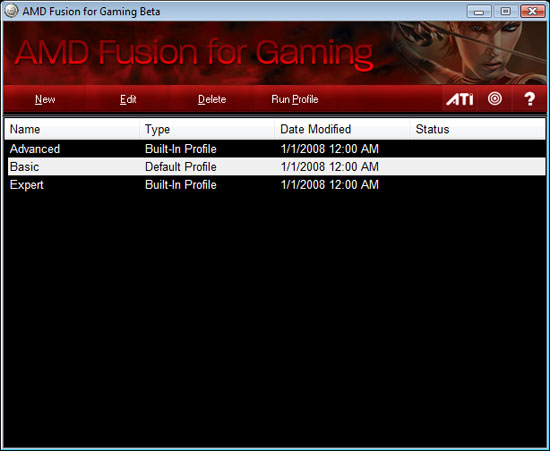
Four months after making its beta debut, AMD's Fusion for Gaming utility has now reached version 1.0 and is available for download. Working on systems equipped with AMD CPUs, Fusion for Gaming will temporarily shut down background processes and intensify processor performance in order to increase overall gaming performance.
To download Fusion for Gaming 1.0, click on the link below:
As well as launching its new Fusion marketing campaign, AMD has also used its favourite new name for the Fusion for Gaming utility. This isn’t just another Windows overclocking app, though; the idea behind the utility is that it unclogs all the surplus processes from your PC before you run a game as well.
This application is targeted at the not-so-hardcore gamer who still wants to get the most out of his or her system. The idea is that at the press of a button that sits on your desktop, you could engage a system state that is more gaming friendly.
There are two factors at work here. The first is overclocking via a link between the Fusion for Gaming utility and AMD’s Overdrive software and the Catalyst Control Center, which allows the utility to overclock your CPU and graphics card. The second is that PC gaming performance is often hampered by other background processes and apps that aren’t needed for gaming, such as Skype, and this will automatically be stopped by the Fusion for Gaming utility when you hit the big button on the screen.
AMD showed off the application in a webcast, in which AMD’s desktop gaming strategist, Brent Barry, and the ‘mastermind’ behind the software, Casey Gotcher, demonstrated its features. As a quick demo, the pair used a 2.6GHz Phenom X4 9950 Black Edition with various apps loaded. After hitting the big Fusion button (which initiated a dramatic ‘whoosh’ sound), all of the apps disappeared and the CPU clock speed went up to 2.8GHz via a multiplier increase, which was verified in CPU-Z. When the utility was stopped, the clock speed went back down to 2.6GHz and all the apps appeared on screen again.
You may watch the YouTube video here:
Three modes are available, starting with a Basic Mode that just shuts down a few background processes such as power state switching and AMD’s Cool’n’Quiet technology. Next comes the Advanced mode, which goes a step further by shutting down other apps such as web browsers and word processors as well as background processes, although it will stop if any of the shut-down procedures initiate a Save dialogue. As well as this, AMD also says that this mode can initiate hard drive acceleration designed to ‘decrease data seek time’ via the southbridge. This mode will also overclock the CPU and GPU, although only to a set level.
To get complete control over the overclock you’ll need to use the Expert Mode, which lets you select which programs are stopped, as well as the clock speed of your CPU and GPU. Casey Gotcher explained the reasoning for the different modes, saying that the apps’ target audience ‘wouldn’t necessarily be the heatseeker; the ultimate enthusiast who knows how to tweak every aspect of his system.’
The biggest benefit to the average non-enthusiast consumer would probably be shutting down background applications and restarting them. Things like Windows Defender and virus scanners and messaging programs and email programs and all the little random stuff people like to have up and running while they are surfing the web or getting work done. Any one of these programs might not really impact performance, but having a lot going on just increases the chance of stability and performance issues. An easy way not only to shut all this down, but also to bring them all back up, would go a long way in helping average gamers get more out of their system.
The Fusion for Gaming Utility is currently only supported in Windows Vista 32-bit, although 64-bit support is promised for a later date.
Here is The Future is Fusion Web page where we can download stuffs like AMD Fusion animation, whitepaper, screensaver or even desktop wallpaper : http://www.amd.com/us/fusion/Pages/index.aspx
AMD is a company undergoing a major transformation. They are driving to a more competitive cost structure, while introducing innovative new products and platforms. They are taking place as the graphics performance leader, and about to reignite processor portfolio with 45nm technology. Meanwhile, the new executive team is coming together, aligned around a renewed strategy for success built to deliver consistent profitability, based on focus and execution.
AMD is launching an exciting new brand direction: The Future is Fusion.
With immediate effect, AMD Smarter Choice should be replaced with the new corporate logo.

 News circulating about imminent availability of a new model of desktop APU based on Llano silicon, the A6-3500. Like the four other desktop variants of Llano, this processor will drop into a Socket FM1 motherboard and provide both CPU and graphics processing power to the system.