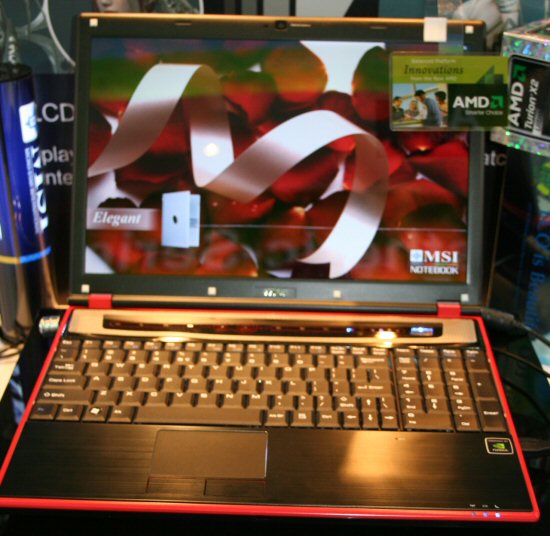
AMD has its sights set on a big cat, Puma, the firm's new platform for mainstream laptop PCs, which it officially announced today. Puma will do battle against Intel's upcoming Centrino 2 platform later this year. For the most part, Puma represents the "mobilization" of AMD's current desktop PC technologies, with a necessarily increased focus on dynamic power and performance scaling.

The various components of the Puma platform will be largely familiar to those who know AMD's desktop products, but the big exception here is the new mobile processor design, code-named "Griffin." Griffin is a mix of old and new, combining a pair of K8-style execution cores with Phenom-style glue logic and power-saving measures. The chipset itself is manufactured on AMD's 65nm SOI process, and each core packs 1MB of L2 cache, for a total of 2MB L2 per chip. AMD says this new mobile processor has three independent power planes, one for each CPU core and a third for its integrated north bridge (with a HyperTransport link and memory controller). Griffin can scale voltage up and down as needed, in response to demand, for each of these three power planes. The north bridge supports HyperTransport 3.0, for added bandwidth, and it can drop from 16 lanes to eight, or even disconnect itself temporarily, in order to conserve power.

The first three Turion X2 Ultra models based on Griffin will be the ZM-86 (running at 2.4GHz with 2MB total L2 cache), the ZM-82 (at 2.2GHz with 1MB total L2), and the ZM-80 (at 2.1GHz with 1MB total L2).
At the other end of the HyperTransport link will sit AMD's new RS780M chipset, the mobile variant of the quite solid 780G chipset, including the SB700 south bridge. This chipset has all of the latest capabilities, including PCIe 2.0, but its biggest claim to fame is its relatively decent Radeon HD 3200 integrated graphics processor. AMD expects Puma's IGP to outperform anything Intel has to offer for Centrino 2 easily, a credible claim given the desktop variant's relatively strong performance. This IGP includes the UVD logic built into all recent Radeons, so it's capable of providing extensive decode offloading for the major high-definition video formats.
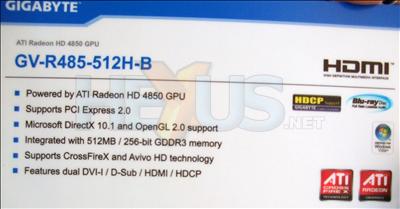
The chipset's IGP will be getting assistance from other Radeons in various ways. Hybrid graphics capability, marketed under the name PowerXpress, will allow a Puma-based system to switch between an IGP and a discrete GPU in order to optimize performance or battery life. For instance, the firm claims a laptop with a discrete Radeon HD 3650 can deliver over 2.4 times the throughput of the IGP, while popping into IGP mode and disabling the discrete GPU can prolong battery life by over 90 minutes. Users can switch between the two modes with a keystroke—no need for a reboot—or a system can be configured to switch automatically from discrete to integrated graphics when it's unplugged from a power outlet (and vice-versa).
The dynamic range possible with PowerXpress is expanded substantially by the mobile version of the Radeon HD 3800 series GPUs.
As ever, AMD hasn't attempted to create its own wireless networking solutions for Puma, instead preferring to rely on partners like Atheros, Broadcom, Marvell, and Ralink for 802.11a/b/g/n and 3G connectivity.
Read this:
AMD Introduces “Puma” Consumer-Oriented Mobile PlatformEarly Hands on with new AMD Puma and Toshiba A300Also see this:
Event photos on AMD Puma Launching