Monday, August 30, 2010

ATI Radeon branding will be changed to AMD Radeon

The rumors are true! AMD intend to phased out the ATI logo on future branding of graphics processors, which are developed by engineers of ATI Technologies, which AMD acquired back in 2006.

A major motivator is the fact that AMD plans to introduce a range of new products incorporating both AMD microprocessor technology and a Radeon graphics tech on the same chip. The first fruits of the CPU-GPU "Fusion" initiative are slated to arrive soon. "Ontario," which will combine two copies of the low-power "Bobcat" CPU core with Radeon graphics, is slated to ship before the end of the year. The more powerful "Llano" APU, which mates quad Phenom II-class CPU cores with presumably a more capable GPU, is scheduled for the first half of 2011. Obviously, the combination of the firm's CPU and GPU technologies into single-chip products could create some consumer confusion, if folks were to continue to think of AMD and ATI as separate entities—especially if the ensuing marketing messages emphasize the benefits of CPU-GPU integration.

Furthermore, AMD tells us it feels confident in making this change right now because its graphics business is "on good track," having surpassed rival Nvidia in discrete graphics shipments last quarter, according to analyst estimates, and having secured high-profile design wins with the likes of Apple. Also, the chastening of Intel via its settlement with the FTC gave AMD some extra assurance that the expansion of its brand into graphics wouldn't hurt its relationships with major PC makers.

According to AMD's own survey results, consumers savvy enough to know something about discrete graphics cards tend to know the Radeon name, they tend to like AMD, and they don't mind seeing the AMD name on graphics cards once they realize AMD merged with ATI. The folks at AMD read those results as "permission" to jettison the ATI brand name.


The plan is to replace "ATI Radeon" and "ATI FirePro" with "Radeon" and "FirePro", along with a sprinkling of AMD corporate identity. The badges you see above will be used for systems with discrete Radeon and FirePro graphics cards. The lower row omits the AMD logo, so PC makers shipping Intel-based systems will be able to avoid the oil-and-water combo of Intel and AMD branding, if they wish.

However, end-users are likely to miss the ATI logotype since in general people associate the brand with high quality, performance, experience and so on. Besides, 25-years old trademarks like ATI are generally recognizable.

Some analysts said the re-branding of ATI Radeon into plain Radeon may become the worst branding decision ever made by AMD due to the fact that ATI has a larger scope on the market of discrete graphics chips than AMD does on the market of CPUs.

Official statement from John Volkmann : Evolving the AMD Brand Portfolio

Saturday, August 28, 2010

AMD Reveals Peculiarities of Bobcat Design

Bobcat micro-architecture will power AMD's next-generation central processing units (CPUs) for netbooks and other innovative form-factors that require very low power chips. The Bobcat seems to be by far more progressive than Intel Atom, but it will consume more power and its performance is likely to be considerably better.

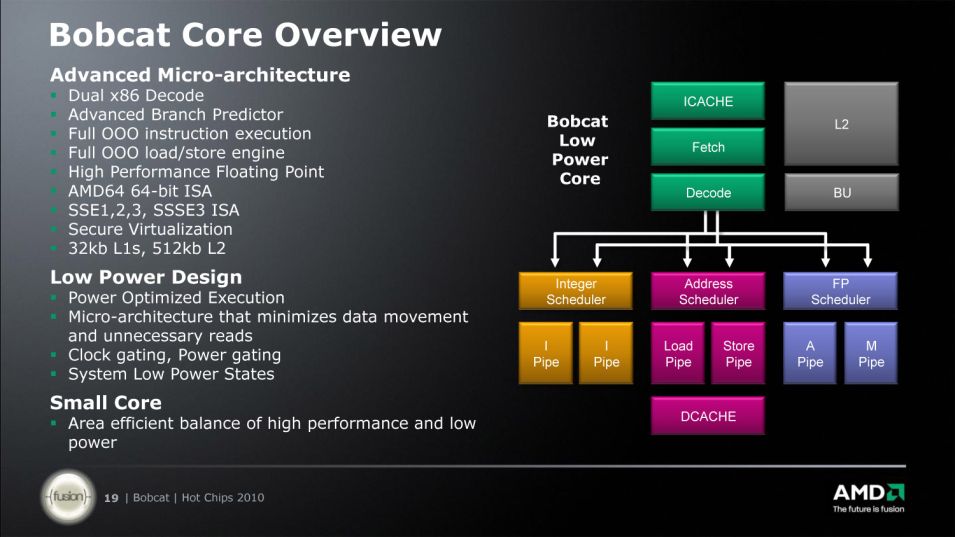
When AMD started to design Bobcat back in 2005 - 2006, it already knew that its K7/K8/K9 chips were too power hungry for mobile computers, whereas the preceding generations were too inefficient in modern workloads. As a result, the company decided to design the chip from scratch rather than to "borrow" designs from previous-generation products. However, AMD decided not to sacrifice performance in order to absolutely minimize power consumption. As a result, Bobcat seems to be almost completely contemporary chips with numerous design trade-offs to reduce power consumption. According to AMD, the micro-architecture minimizes data movement and unnecessary reads from cache or memory.


The Bobcat core sports out-of-order execution, advanced branch predictor, dual x86 instruction decoder, 64-bit integer unit with two ALUs, floating point unit with two 64-bit pipes, 32KB instruction cache, 32KB data cache, 512KB L2 cache (working at half speed to trim power consumption) and so on. Bobcat fully supports modern SIMD extensions like SSE, SSE2, SSE3, SSSE3, SSE4A, but no 3DNow, AVX and so on. AMD Bobcat features an extensive set of means to reduce power consumption, including such capabilities as fine grain clock gating, integrated core power gating and so on.

The first implementation of Bobcat will be Ontario chip that features one or two x86 processing cores as well as DirectX 11 graphics processing unit from ATI. The chip will be made using 40nm process technology at TSMC and will be released commercially in Q1 2011.

Friday, August 27, 2010

First Details about Bulldozer

Advanced Micro Devices revealed numerous details about the Bulldozer micro-architecture, which will power the company's next-generation central processing units (CPUs) for desktops, servers and workstations. Apparently, the main goal of AMD's designers when it came to Bulldozer was to ensure maximum sharing of resources within multi-core microprocessors to get high performance amid moderate low power and die sizes.

Traditional approach to creation of multi-core microprocessor is very straightforward: each core acts independently and shares only the most obvious resources with other: L3 cache, memory controller, processor bus, etc. In Bulldozer designs, cores will be able to dynamically share fetch and decode blocks, caches and other units. At least in initial designs, multi-core chips will consist of several major blocks, each of which will have two independent integer cores (that will share fetch, decode and L2 functionality) with dedicated schedulers and two 128-bit FMAC pipes with one FP scheduler. This means that each major block (Bulldozer Module) is, according to AMD, essentially a tightly-linked dual-core microprocessor with shared fetch, decode and floating point units.


Such "dual-core" major block will not be as efficient as two traditional cores, but will consume less power and will use less die space, which in effect means that more of major building blocks can be installed without increasing thermal design power or die size to unacceptable levels. Moreover, AMD reasonably claims that the approach is more efficient than simultaneous multi-threading or chip-level multi-threading. In fact, according to AMD, each major block can provide 80% performance of a dual-core microprocessor.

AMD also implied that Bulldozer will feature a new predication-directed instruction preset mechanism to overlap instruction miss requests to cache or memory and thus improve efficiency of execution. In particular, this will help AMD to maximize utilization of the "dual-core" major blocks of Bulldozer microprocessors.

Given the fact that AMD's Bulldozer architecture seems to be very modular, we can expect AMD to tailor designs in accordance with performance and/or power requirements.


The first Bulldozer processors will be made using 32nm SOI fabrication process in 2011 and that with 33% increase of the number of cores, up to 50% of additional performance may be received in server applications, at least, based on AMD's internal simulations.

More info : TechReport - AMD's Bulldozer architecture revealed

Friday, August 20, 2010

AMD reduces CPU prices to keep market share

AMD recently reduced prices for about 20 of its desktop processors. According to sources from motherboard players, the price cuts are aimed at defending against competition from Intel.

AMD's quad-core Athlon II X4 640 CPU has seen its price drop from US$122 to US$99, while the dual-core Phenom II X2 555 Black Edition CPU dropped from US$105 to US$93, and the quad-core Phenom II X4 955 and 965 Black Edition both dropped US$26. Most of the company's other processors have seen drops up to US$10.

The above prices only apply to "direct" AMD customers buying CPUs in trays of 1000, but the savings should start trickling down to street prices. So stay tuned!

Friday, August 13, 2010

Upcoming AMD CPU & GPU Update

New Phenom II and Athlon II are scheduled for launching on September 21. Leading the new batch will be the Phenom II X6 1075T. With a $230-240 price tag and a 3GHz clock speed (or 3.5GHz with Turbo Core), that part should bridge the gap between the $199 1055T and the $295 1090T.

At the same time, the 3.5GHz Phenom II X4 970 should become AMD's new quad-core flagship. There will be two types of AMD Phenom II X4 970 BE CPUs: boxed versions aimed at retail market will be based on the well known code-named Deneb design that has four cores in total; tray flavours of the chips designed for system integrators and OEMs will be based on Zosma design, which is basically six-core Thuban chip with two disabled cores that can be unlocked on certain mainboards.

Also coming : a couple of CPUs priced at around $100: the Phenom II X2 560 and Athlon II X4 645. The new parts will indeed be 100MHz quicker than the existing Phenom II X2 555 and Athlon II X4 640, or 3.3GHz and 3.1GHz.

Meanwhile, AMD is preparing to introduce the Radeon HD 6000-series (Southern Islands) formally in October with retail availability to follow in November. DigiTimes claims that changes in foundry firm TSMC's roadmap led AMD to scrap plans for 32-nm GPUs (code-named Northern Islands) and build Southern Islands products using the same 40-nm process as today's Evergreen chips. Build on the same 40nm, savvy pricing and architectural improvements should be the only weapons at the new Radeons' disposal.

DigiTimes adds that AMD will cut prices across the Radeon HD 5000 series "in the near future".

Monday, August 9, 2010

KaraokeSys 1.1 Released

KaraokeSys is a Karaoke Management Software that simply needs a Windows based computer with dual monitor (or a projector) and sound enabled. No need to worry about damaged VCD discs anymore. Your favorite MPEG videos were stored on your PC and easily launched via this multifunction software.

Highlighted features:
  1. Multiple monitor support to view live video at secondary screen while still doing anything else in the primary screen (including searching and selecting songs)
  2. Manage songs (add, edit, delete, and multiple edits of song properties)
  3. Drag & drop files to upload songs
  4. Search anything (any displayable text within title, artist, genre, and even tag)
  5. Manage playlist (add and delete songs for future use)
  6. Play, pause, stop, next song, previous song (this is very obvious)
  7. Switch to left, right, or stereo audio channel for vocal + music or music only
  8. Pitch control (transpose –12 to +12) [NEW]
  9. Tempo control [NEW]
  10. Volume control
  11. Preview song in mute volume

Screenshots:


Friday, August 6, 2010

Apple’s New iMac & Mac Pro Powered by ATI Radeon

Apple has selected the world renowned ATI Radeon™ graphics solutions for the new line of Apple® iMac® and Mac Pro® tower. Now featured in Apple Stores as well as online retail, ATI Radeon graphics offer outstanding power and performance as the standard configuration for the new iMac and Mac Pro tower which will hit store shelves soon.

“Apple buyers demand the best, and AMD’s award-winning ATI Radeon graphics enable exceptional visual experiences for iMac users,” said Matt Skynner, corporate vice- president and general manager, GPU division, AMD. “AMD has conducted extensive testing and research to create superior graphics products for the iMac. This research is designed to dramatically enhance the Mac-user experience so that Apple users can enjoy responsive performance and play the newest games.”

The high-performance ATI Radeon™ HD 5770 graphics card features 1GB of GDDR5 memory from AMD and enables blistering fast Mac Pro graphics technology. Ideal for motion graphics, 3D modeling, rendering, or animation, the card comes standard; for more demanding tasks purchasers can upgrade to ATI Radeon™ HD 5870 graphics.

ATI Radeon™ HD 5750 graphics are available in the new 27” iMac. The ATI Radeon™ HD 5650 graphics are available in the new 22” and 27” iMac.  Last but not least, ATI Radeon™ HD 4670 graphics are available in the new 22” iMac .

Friday, July 30, 2010

StarCraft II only takes advantage of dual cores

StarCraft II: Wings of Liberty has now been available via digital distribution servers. StarCraft II marks the return of the three races from the original game: Protoss, Terran, and Zerg. This first installment only features the Terran campaign, with two planned expansion packs “Heart of the Swarm” and “Legacy of the Void” which will allow gamers to play the Zerg and Protoss campaigns.

The bad news is StarCraft II only takes advantage of dual cores, but still processing power plays a major role in this game. For example, the Core i3 540 processor only has half the L3 cache of the Core i5 750 and this makes the latter 27% faster when comparing the clock for clock data at 3.70GHz.


The extra threads of the Core i7 920 processor are no advantage when compared to the Core i5 750 in this game, but the additional memory capacity and bandwidth is. The Core i7 920 was 11% faster when comparing the clock for clock data at 3.70GHz which is quite significant.


An older processor like the Core 2 Quad Q6600 suffers compared to the other CPUs tested, serving as a bottleneck to a high-end GPU such as the GeForce GTX 480. The Phenom II processors delivered average performance and we saw no real difference between the Phenom II X2 (dual-core) and Phenom II X4 (quad-core processors).

It is a shame that StarCraft II can only utilize two cores, as this really hurts older quad-core processors such as the Core 2 Quad Q6600. Furthermore this will also mean that those with budget quad-core processors, such as the Athlon II X4, will also suffer.

Thursday, July 29, 2010

AMD considering its own USB 3.0 implementation

AMD is getting ready to sign a deal with Renesas that will give AMD access to Renesas USB 3.0 implementation. This would allow AMD to quickly implement a stable USB 3.0 solution into its chipsets without having to spend time and money on developing its own solution and more importantly, software stack.

We’re hearing reports of Renesas competitors having problems with their software stacks and this is why we’re still waiting for all but Fresco Logic to get their products approved by the USBIF. If this rumour proves to be true, then it means that AMD has had enough of Intel’s silly game and decided to move forward without the blessing of Intel’s xHCI spec.

Digitimes claim that the first chipset from AMD to incorporate USB 3.0 support should be the Hudson D1 southbridge which is meant to go with AMD’s upcoming Ontario APUs which are set to launch sometime in the fourth quarter. This also means that we’ll see USB 3.0 from AMD on its notebook platform first, rather than its desktop platform which is usually the case for new technologies like this.

We’re starting to wonder how much Intel’s xHCI spec really matters, especially as Intel is in no hurry to launch its own USB 3.0 supporting chipset. NEC must also be kicking itself for selling off the NEC Electronics division to Renesas, as from what we’ve been told, NEC only expected USB 3.0 to be profitable for about six months or so before it got integrated into chipsets. Now it looks like this time period might well extend over two years or longer when it comes to Intel chipsets, as we have yet to hear or see anything that suggests that Intel will add USB 3.0 support to its chipsets over the next twelve months.

Thursday, July 15, 2010

AMD Technology Helps Bring “Predators” To Life on the Big Screen

Troublemaker Studios utilized Six-Core AMD Opteron™ processors and ATI FirePro™ graphics accelerators to create animations and special effects for the new film “Predators”, now in theaters. Produced and executive directed by acclaimed film maker, Robert Rodriquez, Predators stars Academy Award winning actor Adrien Brody in a tale about a group of elite warriors who come to realize they’ve been brought together on an alien planet…as prey.

With a long history in the movie making industry, Troublemaker Studios is using AMD technology to push the envelope of digital movie making and special effects in several blockbuster films.

In addition to “Predators”, Rodriguez has looked to AMD technology to create six of his movies, including “Shorts”, “Spy Kids 2: The Island of Lost Dreams”, “Spy Kids 3D: Game Over”, “Planet Terror”, and “Sin City”.

Rodriguez’s next film, “Machete”, is currently in production employing AMD technology as the movie’s digital hardware backbone, and is expected to be released on September 3, 2010.

The creative team at Rodriguez’s Troublemaker Studios use workstations based upon AMD’s superior ATI FirePro V8800 graphics solutions and Six-Core AMD Opteron processors which enable the digital artist to create and iterate at the speed of thought.”

“With the AMD platforms, my creative team has the freedom to quickly design and animate all the required concepts and designs,” said Robert Rodriguez, Troublemaker Studios. “AMD’s complete platform solution helps turn our visions into reality – we can easily and quickly manipulate images or scenes without the wait process previously associated with computer technology.”

Popular Posts