Tuesday, February 9, 2010

Radeon HD 5570 launches at $79-85


AMD has now added a third sub-$100 graphics card to its DirectX 11 lineup. The new Radeon HD 5570 fits squarely between HD 5670 and HD 5450 with a $79-85 suggested price range.

AMD based the Radeon HD 5570 on the same 40-nm Redwood graphics processor that powers the 5670. Users will still get 400 stream processors, five texture units (for 20 texels/clock fill rate), two ROP units (for a total eight pixels per clock), and a 128-bit memory interface. However, the core clock speed has fallen from 775MHz to 650MHz, and instead of speedy 4Gbps GDDR5, AMD has limited the 5570's memory selection to 1.8Gbps DDR3.

As a result, floating-point number crunching power has fallen from 620 gigaFLOPS on the Radeon HD 5670 to 520 gigaFLOPS on the Radeon HD 5570, and memory bandwidth has dropped similarly from 64GB/s to just 28.8GB/s. These changes appear to have helped the 5570's power efficiency—AMD quotes a "typical" 38W at load, down from 61W. In turn, the reduced power consumption enables a half-height form factor and a smaller cooler. AMD tells us we could actually end up seeing passively cooled 5570s from
some card vendors.

Reviews:
AnandTech
Tom's Hardware
Legit Reviews

Sunday, February 7, 2010

“Thuban” to Get Dynamic Speed Boost Technology

Advanced Micro Devices plans to implement a dynamic performance boost technology into its six-core processors known as Phenom II X6 “Thuban”.

The software is seriously behind the hardware and many applications still cannot take advantage of additional cores, but fully depend on clock-speeds. In order to provide maximum possible performance in such programs, developers of CPUs implement special dynamic performance boosting technologies that disable certain cores and overclock the rest.

When single-thread performance is needed most, Thuban processors will automatically disable idle cores and overclock the remaining engines to the maximum possible level that is determined by general thermal design power. The technology will be completely hardware-based, hence, will work in any operating system that supports six-core chips. The technology is presently called “C-state performance boost”, however, it is more than likely that AMD will introduce a better sounding marketing name when it launches six-core chips in the second quarter of the year.

Thursday, February 4, 2010

ATI Radeon HD 5450 "Cedar"

Four chips in 6 months reaches its end today, with the launch of the final chip in AMD’s Evergreen stack: "Cedar". Cedar, the baby of the family, will be powering AMD’s bottom-tier cards. Today we’re seeing the the first of what we expect will be a couple of Cedar cards with the launch of the Radeon HD 5450. The ATI Radeon HD 5450 graphics card delivers a state-of-the-art HD multimedia and game experience at a value price. You can expect to find listed soon for $49-59.

The Radeon HD 5450 has 292 million transistors, 80 stream processors, two texture units (each capable of filtering four texels per clock cycle), and a single ROP that can push out four pixels per clock. Radeon HD 5450 graphics cards will have a 650MHz core clock speed, up to 1GB of DDR2 or DDR3 memory with a 1.8Gbps top data rate, and 64-bit memory interfaces. (The $49 part will only have 512MB of RAM, however.)

AMD has a product page for their new Radeon 5450. Radeon HD 5450 Reviews:
AnandTech
Hot Hardware

Monday, February 1, 2010

Zosma is the new AMD 45nm Quad Core

Delta Leonis is a star in the constellation of Leo and natives calls it "Zosma". Some even calls it Zozma or Duhr. AMD’s next generation 45nm quad core is codenamed Zosma.

Expected to be released as early as Q2 2010, it is set to launch together with three new Hexa cores Phenom II X6 "Thuban". Some suspected that Phenom II X4 960T 95W TDP quad-core is a six-core with two cores disabled.

We don’t know any clock speeds but it is a 45nm SOI part, supports DDR3 1333 and fits in AM3 motherboards.

Monday, January 25, 2010

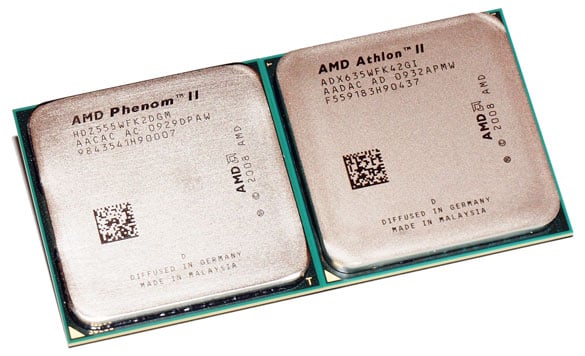
AMD's Refresh : Phenom II X4 910e, X2 555 BE; Athlon II X4 635, X3 440, X2 255


AMD has released 5 new CPUs for the New Year. Thanks to continued improvements in Global Foundries' 45nm process, AMD is delivering slight clock bumps for its dual, triple and quad-core processors while dropping prices of others.

The new line-up of processors AMD is introducing today consists of the following products...
Phenom II X2 555 - $99
Athlon II X4 635 - $119
Athlon II X3 440 - $84
Athlon II X2 255 - $74
Phenom II X4 910e - $169

The Phenom II X2 555 BE - AMD's Fastest Dual-Core

Remember the Phenom II X2 550 BE? That was a quad-core Phenom II with two cores disabled, but a full 6MB L3 cache. It was a beast of a dual-core CPU but AMD quietly pulled it off its price list months ago. You could still find the chips in retail and priced quite effectivley at $99, but the Core i3 530 manages to offer better performance at nearly the same price.

AMD's response? The Phenom II X2 555 BE. Still an unlocked Black Edition part, the 555 pushes its clock speed up to 3.2GHz. The extra 100MHz won't do much for performance but the price remains at $99. This chip now supports hardware C1E, like the first Athlon IIs. The hardware C1E means lower idle power consumption and it's courtesy of the new C3 Phenom II stepping.

Reviews :
AnandTech
Hot Hardware

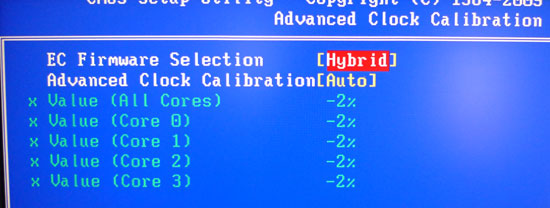
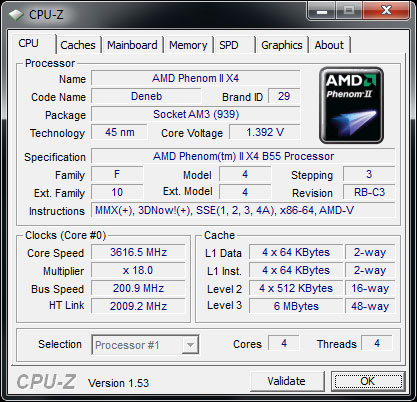
Anandtech has unlocked the Phenom II X2 555 and managed to get it to a quad core at 3.2GHz. They used Gigabyte's GA-MA790FXT-UD5P motherboard. In its BIOS there's an option for Advanced Clock Calibration. All you need to do is set EC Firmware Selection to Hybrid, and ACC to Auto:


Overclocking is affected. With only two cores active the Phenom II X2 555 BE could run at 3.8GHz without any additional voltage. With four cores active, that number drops down to 3.6GHz.

Thursday, January 14, 2010

Radeon HD 5670 "Redwood"


AMD's DirectX 11 Evergreen family is now proceeding to mainstream arena. We're getting to see the Radeon HD 5670, which should start for about $99. Nicknamed "Redwood", it contains half the execution resources of Juniper, the GPU in Radeon HD 5700-series cards, with the same 128-bit memory interface.

According to AMD, the 5670 will draw just 14W at idle and 61W under a typical load. That means no PCI Express power connectors and hopefully low noise levels, despite the spartan-looking single-slot cooler. The core of the new card runs at 775MHz with 400 stream processors for the core and 1GHz with either 512 MB of 1GB of GDDR5 memory.

AMD advertises Eyefinity support, too, but the maximum number of supported displays is limited to four, and the reference card will only connect up to three displays.

Reviews:
Tech Report
AMDZone
AnandTech

AMD's prized primate, Louie, shows just how easy it is to upgrade your PC with a new ATI graphics card, letting you play the latest games. Want to learn more? Check out http://links.amd.com/SoEasy

Friday, January 8, 2010

World’s First Mobile Graphics with DirectX 11 Support


AMD today introduced its lineup of next-generation DirectX 11-capable ATI Mobility Radeon™ Premium graphics. AMD has based the Mobility Radeon HD 5800 series on the same 40-nm Juniper silicon as the desktop Radeon HD 5700 series. The Mobility 5700 and 5600 series are both based on Redwood, while the 5400 series is based on Cedar.

There's no Cypress here. That chip specifically for desktop cards like the Radeon HD 5870, and it's basically too big and too hot for laptops.

Speaking of power efficiency, the new Mobility 5000 lineup features "improved engine and memory clock scaling and clock gating," which helps lower power consumption at idle. AMD allows real-time switching between integrated and discrete graphics processors, too, so users can disable their discrete Radeons in order to get longer battery life. The switching technology supports both Intel and AMD platforms.

Other features include Eyefinity hexa-display capability, which you'll find on Mobility 5800-, 5700-, and 5600-series GPUs. Those who opt for Mobility 5400-series parts will be limited to quad-display setups. All of these GPUs also support up to 1GB of GDDR5 RAM, although you may see some of the lower-end parts with smaller amounts of DDR3 or DDR2 RAM. The choice will likely be up to laptop makers.

Thursday, January 7, 2010

Lenovo ThinkPad Edge


AMD today celebrated an expansion of its business relationship with leading computer manufacturer Lenovo, which is introducing new AMD platform-based laptops. The innovative PC manufacturer this week introduced the first commercial ThinkPad laptops based on VISION Pro Technology from AMD, a new extension of VISION Technology from AMD, that are designed to appeal to key enterprise, SMB and government segments: the ThinkPad X100e, an entry ultraportable starting under $449, and the ThinkPad Edge Series laptops designed for the SMB, starting from $579.

Priced right and engineered for small business, ThinkPad Edge is truly mobile and reliable, with features:
* Powerful AMD dual-core processors
* Windows® 7 operating system
* Gigabit LAN, WWAN with GPS, 802.11bgn WiFi, Bluetooth and WiMAX options
* Thin and light with a 13.3" widescreen
* Spill-resistant keyboard
* Up to 7.8 hours of battery life
* Worry-free ThinkVantage® Technologies
* Enhanced multimedia and HD audio
* Low-light-sensitive Web camera
* Three USB ports (1 powered), 5-in-1 media card reader and HDMI
* Various services and warranty options

The ThinkPad® Edge 13" model features a progressive new design, with clean lines and bold color and finish choices. For more, visit HERE.

Lenovo also plans this quarter to introduce a new IdeaPad based on the 2009 AMD Mainstream Notebook Platform, targeted at the consumer mainstream volume market.

Tuesday, January 5, 2010

Vision Pro Technology

On January 5th, AMD announced VISION Pro Technology, a new commercial PC platform brand that delivers a superior visual computing experience, and can help businesses increase productivity and gain competitive advantage by enabling visually stunning communications, marketing and sales materials.

Graphics matter more than ever in business communication and innovative companies are leveraging balanced PC platform technology to generate and view rich visual presentations including videos and 3D graphics to communicate winning ideas.

Commercial PCs based on VISION Pro Technology from AMD offer out-of-the-box support for multiple monitors, seamless viewing of videos, use of video conferencing software, and the performance necessary to create and view rich presentations with embedded video and 3D graphics.

Additional industry support comes from HP which offers VISION Pro Technology from AMD on select models of its HP ProBook line of business notebooks. The HP ProBook 4415s, ProBook 6445b, and ProBook 6545b are powered by VISION Pro Technology from AMD, enabling these notebooks to deliver compelling PC-based visual support for all forms of business communications including sales presentations, webcasts, and videoconferences.

Security features supported by VISION Pro Technology include the Trusted Platform Module (TPM), AMD’s Enhanced Virus Protection (EVP), and key Windows® 7 Professional features3. AMD client virtualization technology [AMD Virtualization™ (AMD-V™) technology] provides the full, chip-level optimization needed to support legacy applications under Windows XP Mode3.

Find out more about Lenovo and their new ThinkPad Edge and ThinkPad X100e notebooks featuring VISION Pro technology from AMD.

Wednesday, December 23, 2009

PCP+ Baby Raptor

The legendary Baby Raptor :

* AMD™ 790GX + AMD™ SB750 Chipset
* Supports AMD™ AM3/AM2+/AM2 series processors
* Supports Dual Channel DDR2/DDR3
* Integrated ATI Radeon HD 3300 GPU
* Onboard sideport memory 128MB DDR3
* Support AMD OverDrive (AOD) Technology
* Support Advanced Clock Calibration (ACC) Technology
* Supports ATI Hybrid CrossFire Technology
* Supports ATI CrossFireX Technology
* High-polymer solid electrolysis aluminum capacitors
* Integrated Serial ATA2 3 Gb/s with RAID function
* Integrated Gigabit LAN
* Integrated ALC883 HD Audio CODEC with 8-CH
* Supports Blu-ray/Full HD DVD playback
* CPU Vcore 7-Shift
* Onboard DVI Port/HDMI port/VGA port/e-SATA port
* Micro ATX Form Factor (245mm x 245mm)

Popular Posts