Friday, October 22, 2010

AMD introduce Barts-based Radeon HD 6800 series

The company has released the first official photos of the Radeon HD 6870 and HD 6850. Barts PRO and XT parts feature a 255mm2 die size. This is quite good as Radeon HD 5850 and 5870 had 334mm2 size. The chip is almost 30 percent smaller and the new one consumes up to 151W in the XT version, which is less than the Radeon HD 5850 series. Radeon HD 5850 had 2.15 billion transistors while the Radeon HD 6850 and 6870 have 1.8 billion.


Thanks to generally refined DirectX 11 architecture, 256-bit GDDR5 memory controller, increased clock-speed (despite of decreased amount of stream processors and texture units) as well as improvements like better tessellation module amid smaller die size hence lower price, the new Radeon HD 6870 seems to be generally more competitive than the previous-generation Radeon HD 5850. It is especially notable that now both models 6850 and 6870 support up to six monitors, not a mainstream feature that will be sported by $179 and $239 graphics cards.

In the new generation Northern Islands processor - when it comes to the Radeon HD 6800 - several improvements to the tessellation unit was made. In particular, the company improved thread management for domain shaders and re-sized some queues and buffers to achieve significantly higher peak throughput, particularly at lower tessellation levels. Even though the changes had negligible impact on transistor count or power consumption, two times higher the tessellation rate in synthetic tests is declared by AMD.

The AMD Radeon HD 6800 series graphics cards are the first in the industry to offer support for both DisplayPort 1.2 and HDMI 1.4a, providing PC users with expanded options for multi-monitor configurations, display selection, and new DisplayPort audio features. Thanks to new drivers, the new graphics boards also feature better support for third-party stereo-3D (S3D) middleware.


Reviews:
Legit Reviews-AMD Radeon HD 6850 and 6870 CrossFire Video Card Review
Hot Hardware-AMD Radeon HD 6870 & 6850 Graphics Cards Debut
Tom's Hardware-AMD Radeon HD 6870 And 6850: Is Barts A Step Forward?
Anandtech-AMD’s Radeon HD 6870 & 6850: Renewing Competition in the Mid-Range Market

Monday, September 20, 2010

Intel Selling Upgrade Card to Unlock

Intel is asking customers to pay extra if they want the full power of their store-bought silicon. An eagle-eyed Engadget reader was surfing the Best Buy shelves when he noticed this $50 card --


and sure enough, Intel websites confirm -- that lets you download software to unlock extra threads and cache on the new Pentium G6951 processor. The chip actually have a full 1MB of L3 cache that's enabled plus HyperThreading support.

This 'new' idea is similar to online games idea that let you "BUY" extra weapons and features with voucher cards. Still, it's an intriguing business model, and before you unleash your rage in comments, you should know that Intel's just testing it out on this low-end processor in a few select markets for now (United States, Canada, the Netherlands, and Spain).

In fact, this is the very first time in history, when a hardware maker enables a software upgrade. Interestingly, how much time will it take hackers to enable the application to all owners of Pentium-based systems? Or maybe that was indeed the plan to slowdown sales of CPUs by Advanced Micro Devices?

Tuesday, September 14, 2010

AMD Zacate Demo Video

Demonstration of AMD's upcoming Fusion architecture Accelerated Processing Unit code named "Zacate." In the video Simon Solotko demonstrates accelerated web applications, flash video, 3D gaming, and HD video playback on the 18W TDP dual core APU "Zacate."


Zacate has two x86 cores fused together with a DirectX 11 graphics engine. AMD continues to claim that this architecture will work very well in ultra mobile form factors and that it will also be affordable.

Here are some pics of a running AMD Bobcat platform, specifically a Zacate APU running City of Heroes: Going Rogue.


The Zacates compared with a coin:

Wednesday, September 8, 2010

AMD's new stickers

AMD is working on new stickers that manufacturers put on their computers - the stickers, which have been around a while let the consumer know what type of products are inside.


We're used to see the Intel Inside, Centrino, AMD's Better by Design stickers, AMD's Vision or nVidia's sticker and of course the one for Windows, but now things may be getting out of hand when some machines are labeled "Skype Ready".

What's worse is that these stickers are often hard to remove, and can either tear or leave a residue that requires a cleaning job. The reasoning behind the stickers is that companies pay the manufacturer for the 'ad space' of placing a sticker right on the palm rest of a laptop.

AMD knows that computer logo stickers are getting out of hand, and for that reason has consolidated many of its logos into the Vision branding program. Right now, in fact, AMD's logo stickers are optional and vendors that choose not to use the sticker are not penalized in terms of marketing dollars.

AMD is designing case badge stickers to be less sticky. The new stickers will be able to be peeled off more easily, and with little to no residue left behind. This clearly shows that they are taking it a step further and siding with the end users who take them off anyway. If only Microsoft would follow this advice. AMD's new stickers should be out sometime next year.

Wednesday, September 1, 2010

Toshiba's Nile-powered Satellite T235D

For someone who still considers 13" notebooks to offer the best blend of portability and functionality, we saw a lot to like in the Toshiba Satellite T235D. Weighing less than four pounds and measuring only 0.7" at its thinnest point, the larger form factor gets you not just a bigger LCD panel, but also a larger keyboard and touchpad.


Processor AMD Turion II Neo K625 1.5GHz
Memory 4GB DDR3-800 (2 DIMMs)
Chipset AMD M880G
Graphics Mobility Radeon HD 4225 integrated graphics
Display 13.3" TFT with WXGA (1366x768) resolution and LED backlight
Storage Toshiba MK3265GSX 320GB 2.5" 5,400 RPM hard drive
Audio Stereo HD audio via Realtek codec
Ports 2 USB 2.0,1 eSATA/USB 2.0 combo port,1 HDMI
1 VGA, 1 RJ45 10/100 Ethernet via Realtek controller
1 analog headphone output,1 analog microphone input
Expansion slots 1 MMC/SDHC
Communications 802.11b/g/n Wi-Fi via Atheros AR9285
Input devices Chiclet keyboard
Synaptics capacitive touchpad
Internal microphone
Camera 0.3-megapixel webcam
Dimensions 12.7" x 8.8" x 0.7-1.03" (323 x 224 x 18-26 mm)
Weight 3.9 lbs (1.8 kg)
Battery 6-cell Li-Ion (61 Wh)


This particular variant of the T235D-S1345 sells for $599.99 at Newegg. The cheapest 13" laptops with Intel CULV processors, like Acer's Aspire AS3810TZ or Toshiba's own T235-S1310, are priced almost identically at around $590-600.

Monday, August 30, 2010

ATI Radeon branding will be changed to AMD Radeon

The rumors are true! AMD intend to phased out the ATI logo on future branding of graphics processors, which are developed by engineers of ATI Technologies, which AMD acquired back in 2006.

A major motivator is the fact that AMD plans to introduce a range of new products incorporating both AMD microprocessor technology and a Radeon graphics tech on the same chip. The first fruits of the CPU-GPU "Fusion" initiative are slated to arrive soon. "Ontario," which will combine two copies of the low-power "Bobcat" CPU core with Radeon graphics, is slated to ship before the end of the year. The more powerful "Llano" APU, which mates quad Phenom II-class CPU cores with presumably a more capable GPU, is scheduled for the first half of 2011. Obviously, the combination of the firm's CPU and GPU technologies into single-chip products could create some consumer confusion, if folks were to continue to think of AMD and ATI as separate entities—especially if the ensuing marketing messages emphasize the benefits of CPU-GPU integration.

Furthermore, AMD tells us it feels confident in making this change right now because its graphics business is "on good track," having surpassed rival Nvidia in discrete graphics shipments last quarter, according to analyst estimates, and having secured high-profile design wins with the likes of Apple. Also, the chastening of Intel via its settlement with the FTC gave AMD some extra assurance that the expansion of its brand into graphics wouldn't hurt its relationships with major PC makers.

According to AMD's own survey results, consumers savvy enough to know something about discrete graphics cards tend to know the Radeon name, they tend to like AMD, and they don't mind seeing the AMD name on graphics cards once they realize AMD merged with ATI. The folks at AMD read those results as "permission" to jettison the ATI brand name.


The plan is to replace "ATI Radeon" and "ATI FirePro" with "Radeon" and "FirePro", along with a sprinkling of AMD corporate identity. The badges you see above will be used for systems with discrete Radeon and FirePro graphics cards. The lower row omits the AMD logo, so PC makers shipping Intel-based systems will be able to avoid the oil-and-water combo of Intel and AMD branding, if they wish.

However, end-users are likely to miss the ATI logotype since in general people associate the brand with high quality, performance, experience and so on. Besides, 25-years old trademarks like ATI are generally recognizable.

Some analysts said the re-branding of ATI Radeon into plain Radeon may become the worst branding decision ever made by AMD due to the fact that ATI has a larger scope on the market of discrete graphics chips than AMD does on the market of CPUs.

Official statement from John Volkmann : Evolving the AMD Brand Portfolio

Saturday, August 28, 2010

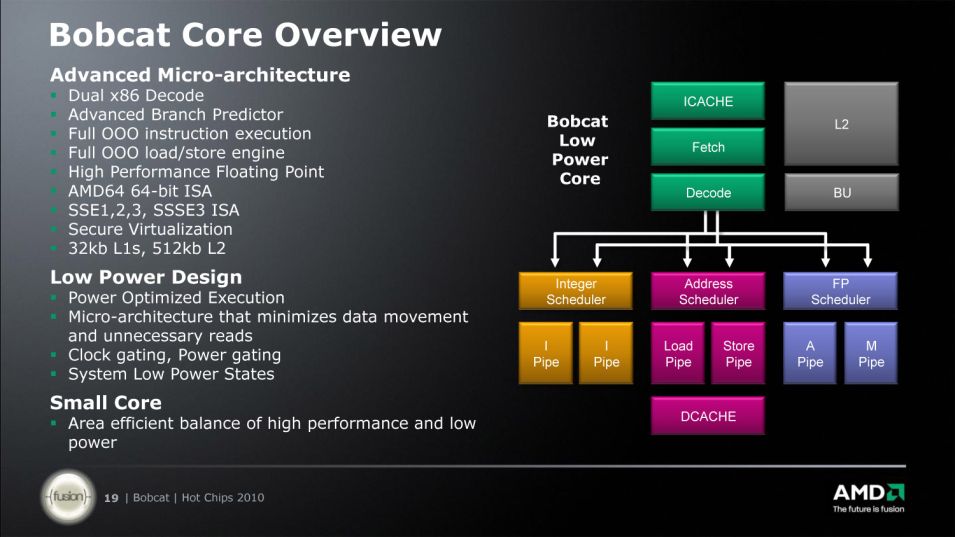
AMD Reveals Peculiarities of Bobcat Design

Bobcat micro-architecture will power AMD's next-generation central processing units (CPUs) for netbooks and other innovative form-factors that require very low power chips. The Bobcat seems to be by far more progressive than Intel Atom, but it will consume more power and its performance is likely to be considerably better.

When AMD started to design Bobcat back in 2005 - 2006, it already knew that its K7/K8/K9 chips were too power hungry for mobile computers, whereas the preceding generations were too inefficient in modern workloads. As a result, the company decided to design the chip from scratch rather than to "borrow" designs from previous-generation products. However, AMD decided not to sacrifice performance in order to absolutely minimize power consumption. As a result, Bobcat seems to be almost completely contemporary chips with numerous design trade-offs to reduce power consumption. According to AMD, the micro-architecture minimizes data movement and unnecessary reads from cache or memory.


The Bobcat core sports out-of-order execution, advanced branch predictor, dual x86 instruction decoder, 64-bit integer unit with two ALUs, floating point unit with two 64-bit pipes, 32KB instruction cache, 32KB data cache, 512KB L2 cache (working at half speed to trim power consumption) and so on. Bobcat fully supports modern SIMD extensions like SSE, SSE2, SSE3, SSSE3, SSE4A, but no 3DNow, AVX and so on. AMD Bobcat features an extensive set of means to reduce power consumption, including such capabilities as fine grain clock gating, integrated core power gating and so on.

The first implementation of Bobcat will be Ontario chip that features one or two x86 processing cores as well as DirectX 11 graphics processing unit from ATI. The chip will be made using 40nm process technology at TSMC and will be released commercially in Q1 2011.

Friday, August 27, 2010

First Details about Bulldozer

Advanced Micro Devices revealed numerous details about the Bulldozer micro-architecture, which will power the company's next-generation central processing units (CPUs) for desktops, servers and workstations. Apparently, the main goal of AMD's designers when it came to Bulldozer was to ensure maximum sharing of resources within multi-core microprocessors to get high performance amid moderate low power and die sizes.

Traditional approach to creation of multi-core microprocessor is very straightforward: each core acts independently and shares only the most obvious resources with other: L3 cache, memory controller, processor bus, etc. In Bulldozer designs, cores will be able to dynamically share fetch and decode blocks, caches and other units. At least in initial designs, multi-core chips will consist of several major blocks, each of which will have two independent integer cores (that will share fetch, decode and L2 functionality) with dedicated schedulers and two 128-bit FMAC pipes with one FP scheduler. This means that each major block (Bulldozer Module) is, according to AMD, essentially a tightly-linked dual-core microprocessor with shared fetch, decode and floating point units.


Such "dual-core" major block will not be as efficient as two traditional cores, but will consume less power and will use less die space, which in effect means that more of major building blocks can be installed without increasing thermal design power or die size to unacceptable levels. Moreover, AMD reasonably claims that the approach is more efficient than simultaneous multi-threading or chip-level multi-threading. In fact, according to AMD, each major block can provide 80% performance of a dual-core microprocessor.

AMD also implied that Bulldozer will feature a new predication-directed instruction preset mechanism to overlap instruction miss requests to cache or memory and thus improve efficiency of execution. In particular, this will help AMD to maximize utilization of the "dual-core" major blocks of Bulldozer microprocessors.

Given the fact that AMD's Bulldozer architecture seems to be very modular, we can expect AMD to tailor designs in accordance with performance and/or power requirements.


The first Bulldozer processors will be made using 32nm SOI fabrication process in 2011 and that with 33% increase of the number of cores, up to 50% of additional performance may be received in server applications, at least, based on AMD's internal simulations.

More info : TechReport - AMD's Bulldozer architecture revealed

Friday, August 20, 2010

AMD reduces CPU prices to keep market share

AMD recently reduced prices for about 20 of its desktop processors. According to sources from motherboard players, the price cuts are aimed at defending against competition from Intel.

AMD's quad-core Athlon II X4 640 CPU has seen its price drop from US$122 to US$99, while the dual-core Phenom II X2 555 Black Edition CPU dropped from US$105 to US$93, and the quad-core Phenom II X4 955 and 965 Black Edition both dropped US$26. Most of the company's other processors have seen drops up to US$10.

The above prices only apply to "direct" AMD customers buying CPUs in trays of 1000, but the savings should start trickling down to street prices. So stay tuned!

Friday, August 13, 2010

Upcoming AMD CPU & GPU Update

New Phenom II and Athlon II are scheduled for launching on September 21. Leading the new batch will be the Phenom II X6 1075T. With a $230-240 price tag and a 3GHz clock speed (or 3.5GHz with Turbo Core), that part should bridge the gap between the $199 1055T and the $295 1090T.

At the same time, the 3.5GHz Phenom II X4 970 should become AMD's new quad-core flagship. There will be two types of AMD Phenom II X4 970 BE CPUs: boxed versions aimed at retail market will be based on the well known code-named Deneb design that has four cores in total; tray flavours of the chips designed for system integrators and OEMs will be based on Zosma design, which is basically six-core Thuban chip with two disabled cores that can be unlocked on certain mainboards.

Also coming : a couple of CPUs priced at around $100: the Phenom II X2 560 and Athlon II X4 645. The new parts will indeed be 100MHz quicker than the existing Phenom II X2 555 and Athlon II X4 640, or 3.3GHz and 3.1GHz.

Meanwhile, AMD is preparing to introduce the Radeon HD 6000-series (Southern Islands) formally in October with retail availability to follow in November. DigiTimes claims that changes in foundry firm TSMC's roadmap led AMD to scrap plans for 32-nm GPUs (code-named Northern Islands) and build Southern Islands products using the same 40-nm process as today's Evergreen chips. Build on the same 40nm, savvy pricing and architectural improvements should be the only weapons at the new Radeons' disposal.

DigiTimes adds that AMD will cut prices across the Radeon HD 5000 series "in the near future".

Popular Posts